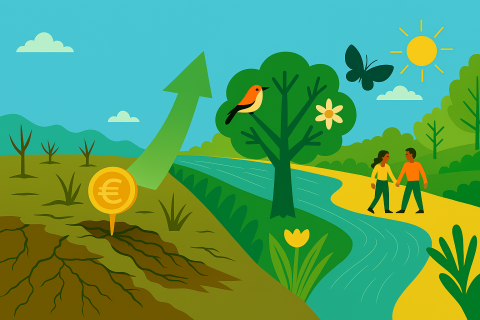
Investing in Nature Restoration – Building a Sustainable Future is an in-person event dedicated to the growing field of nature restoration financing and its benefits for both investors and biodiversity.
One of the key objectives of the LIFE B4B project is to explore innovative and additional financing instruments to support nature and biodiversity restoration. In that context, we are organising a three-day event in June 2026 focused on public and private financing for nature restoration.
Throughout the event, leading experts, practitioners and stakeholders will come together to exchange insights, share experiences and jointly explore concrete solutions for financing nature restoration.
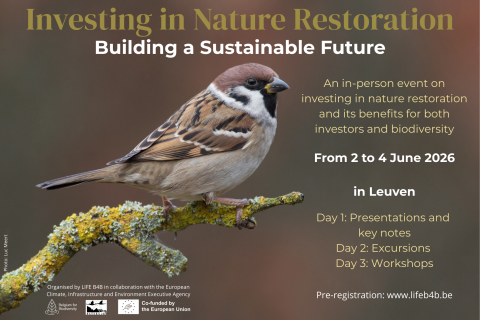
Date and location
2 June 2026 - 4 June 2026 in Leuven, Belgium
Programme
- 2 June 2026 – Plenary sessions (9.30 - 17.30)
- 3 June 2026 – Field visits (9.00 - 17.00)
- 4 June 2026 – Interactive workshops (9.00 - 15.00)
Day 1 - Plenary sessions
The first plenary day we gradually set-up the scene about private funding. Various speakers will talk about their experiences and share their know how. But also explain how private funding works (or not). Several speakers will discuss what kind of financial instruments do exist and can be used or already being used.
We will also explore the needs: what does nature conservation requires but also what does private sector expects from investing in nature. In short: what is the win-win in investing the money in restoring ecosystems.
In the afternoon, Conservation Finance Network of the USA will provide us some perspectives of how private financing works in the United States of America. Followed by some examples in the European Union: concrete cases how certain instruments have been put in practice (or close to market).
During the day enough time will be dedicated to interact with the audience to ask questions but also provide valuable comments and experiences.
No better way to close the day by having an extended reception where you can bring your own regional specialties! What is better to discuss and get to know each other with nice food and drinks!
| Registrations + welcome coffee |
| Introductory talk of the chairman – Harm Schoten (director of Eurosite) |
| Welcome by Goedele Van der Spiegel CEO of the Flemish Agency of Nature and Forests |
| 9:45 - 12:10 Session 1 – Financing the basics |
Tom Andries: LIFE Belgium for Biodiversity (LIFE B4B) – Facilitating financing mechanisms The LIFE B4B project primary objective is to put policy into practice by facilitating processes. This session will explore how financing mechanisms might interact with policy. |
| Angelo Salsi, former head of the LIFE Programme: Some personal reflections and experiences of the past decades. |
Putting Nature on balance sheet: Financial considerations from the demand side In the presentation, Gauthier Clar, senior financial engineering Manager at CINEA, will share its independent and humble views with regard to how to put nature on Investors ‘ balance sheets, to close Nature projects funding gaps attracting investors. The presentation is not endorsed by the EU Commission, but just a modest attempt to discuss key questions and points of attention, for a better integration of these into the construction of Nature Credit markets. |
| Coffee break |
Thomas Machiels – University of Antwerp: Innofins – Financing the urban transition An inspirational session how climate adaptation can be achieved by making use of nature based solutions, financed both by private and public funding. |
Hans Van Gossum: Arcadis – The Business Case for Nature Nature is moving from compliance to strategy. In a world of planetary boundaries, growing regulation, and climate risks, businesses must rethink their relationship with nature. |
| 12.10 - 13.20 Lunch |
| 13:30 - 15:00 Session 2: Spend the money! What are the needs – bridging the gap |
| Peter Howell – Director Private financing and nature conservation, some USA perspective |
| Stephen Hart - European Investment Bank |
| Filip Hebbrecht – Business Conservation Partnerships, how companies co-invest in nature restoration |
Laura Recoder – LIFE Stewardship: private land conservation and financing (Life Stewardship) How private financing could be mobilized to support conservation projects led by NGOs, using land stewardship agreements to strengthen legal certainty and to ensure landowners’ long‑term commitment towards conservation actions. The session will present the first outcomes and lessons learned of the Life Stewardship project that is currently being implemented in Spain. |
| Coffee break |
| 15:30 - 16:30 Session 3: Examples |
| Joke Verduyckt – BNP Paribas Fortis in Belgium – Perspectives of a bank and first experiences. |
| Max Kolb – Presenting the first outcomes of the LIFE LIFE Biodiv CREW project. |
| Emma Terämä – Ministry of the Environment, Finland – Biodiversity credits and roadmap – an example of how policy and public-private funding can contribute to nature restoration |
| 16.30 - 19:00 Closing of the day |
| Harm Schoten - Reflections |
| Instructions excursions |
| Photo moment |
| Reception |
Day 2 - Field visits (9:00 - 17:00)
The objective of the second day is about visiting concrete examples in the field but also to continue networking during some nice excursions. We will visit sites where private investors make the difference and more important, generating win-win situations. Biodiversity loss is halted or even reversed and natural resources are secured which are essential for many enterprises.
Recent studies and reports confirm that 55% of global gross domestic product (GDP) depends on nature. This means that more than half of economic activities depend directly or indirectly on natural resources and ecosystems.
Nature and the economy are closely intertwined: Sectors such as agriculture, fisheries, forestry, tourism, and even some industries such as pharmaceuticals and construction rely heavily on healthy ecosystems and biodiversity.
Reports such as those from the World Economic Forum (WEF) emphasize that nature loss is one of the greatest risks to the global economy.
In short, nature conservation is not only an ecological necessity, but also an economic priority. By investing in sustainable practices, we can leverage this dependency positively and mitigate risks.
Natuurpunt and Natagora have a long expertise in developping Belgian projects where business and nature meet each other.
In this excursion you get to know the approach and how it is to ste up cooperations between public, private and NGO's.
Be sure to provide appropriate clothing for rainy weather and an extra pair of shoes for on the bus.
| Option 1 - Excursion in Flanders |
The excursion in Flanders takes place around the river Dijle. The Dijle flows through the Belgian provinces of Walloon Brabant, Flemish Brabant and Antwerp. It forms part of the Scheldt river basin. The area to the east of Brussels, through which the Dijle flows, is known as Dijleland. In the morning, you will walk through the woods, along the river and in the floodplain. In the afternoon, the bus will take you towards Mechelen, to the Mechels Broek. Here, the focus is more on wetland restoration but also on nature within an urban context.Different Nature actors, NGO's and private compagnies will talk about the restoration in the different sites. During this excursion, much of the travel will be on foot. We estimate that we will walk at least 10 km on flat terrain. If this is a problem for you, we recommend that you choose the other excursion. More info about the different sites:
|
| Option 2 - Excursion in Wallonia |
The excursion in Wallonia starts in Hollogne-sur-Geer, a town in the province of Liège. The area we are visiting forms part of the Haut-Geer nature reserve. In the afternoon, the bus takes us to Waremme. Here, we delve further into the story of nature restoration in collaboration with private partners. One area still needs to be restored, whilst the other is already in the next phase. During this excursion, it therefore becomes very clear what collaboration can achieve in the context of nature restoration.
|
Day 3 - Interactive workshops (9:00 -15:00)
The third day, time to dive deeper into private funding. During several workshops you can discuss topics like biodiversity credits, carbon credits, philanthropic resources, green washing, restoration plans and finances, marine restoration, developing business cases,… etc. The floor is yours.
We’ll start the day with coffee and a brief overview of the programme. This will be followed by three sessions featuring various workshops. In between, we’ll take some time for lunch and a chance to catch up with one another.
The day will end at 15:00 at the latest.
| Registrations + Welcome coffee |
| Parallel workshops part 1 |
| Coffee break |
| Parallel workshops part 2 |
| Lunch |
| Parallel workshops part 3 |
| Closing of the event |
| Topic 1 |
| LIFE Stewardship: this project will present an overview of different financial instruments applicable to nature conservation and restoration, with particular attention to their potential use in land stewardship agreements and other mechanisms of private land conservation. |
| Topic 2 |
| Forum Ethibel: integrating different financial ‘biodiversity instruments’ in an investment structure. This workshop will further explore expectations of investors, bankability, greenwashing, limitations etc. During the workshop different hypotheses will be posed and discussed. |
| Topic 3 |
| Arcadis looks forward to gathering your thoughts on some aspects of habitat banking |
| Topic 4 |
| Biodiversity credits and roadmap |
| Topic 5 |
| Credit systems: Carbon credits |
| Topic 6 |
| Marine environment: opportunities for private investors? (tbc) |
Partner event EU Greenweek
Link to the livestream
Click here to join the livestream
Free of charge
This event is free of charge. LIFE B4B will provide lunch for the 3 days and a receptions on the first day. In keeping with the spirit of LIFE, we would also like to showcase local produce and specialities. We therefore ask participants to bring something from their own region. We will provide a fridge so that everything can be kept fresh and cool.
Day 1 will also be streamed, allowing us to reach an even wider audience.
We are committed to organising this event as sustainably as possible. If you are unable to attend, please let us know in good time so that we can work together to prevent food waste.
Transportation and overnight stay are at the own expence of the participants. The costs for LIFE projects participants are eligible for LIFE.
Venue
Dirk Boutsgebouw
Diestsepoort 6, 3000 Leuven
https://maps.app.goo.gl/17CHhsSJmrrwCS3N8
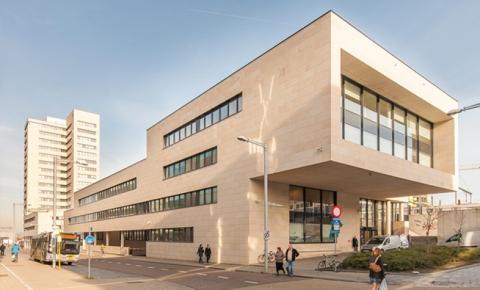
Photo - Facilitair bedrijf VO
How to get there?
By train
The venue is easily accessible from the airport by train. The journey takes about 15 minutes.
The Dirk Bouts building is located next to Leuven's SNCB station, to the right of the main entrance and bus station.
Coming from the platform, walk towards the centre. Just before the underground car park De Bond, turn right towards the bus station (arrow ‘Diestsevest’). This corridor comes out above ground. Follow that corridor and the footpath and you will reach the main entrance to the building.
By bus
The Dirk Bouts building is next to the platforms of De Lijn's ‘Leuven Station’ stop. The bus stop at the front of the station has a wide range of buses. There is also a bus stop at the back of the station (‘Kessel-Lo Back of Station’)
By bike
The entrance to the underground bicycle shed is on the side of the building (bus station side). Employees can use the secure bicycle parking area (with badge). Visitors can, subject to the use of a visitor's badge, use the first part of the bicycle parking area.
What to do in Leuven?
Where to stay?
Visit Belgium
Belgium?